


- admin
- December 1, 2025
- No Comments
CO₂ Laser – Multivaried Use: From Acrylic Cutting to Leather Engraving and Automotive Applications
Introduction
CO₂ laser technology has become one of the most versatile tools used across industries today. Known for its precision, speed, and ability to work with a wide range of non-metal materials, a CO₂ laser can perform both cutting and engraving with exceptional accuracy. From signage and décor to automotive production, its applications continue to expand as businesses look for efficient and high-quality manufacturing methods.
How CO₂ Laser Works
A CO₂ laser produces a powerful, focused infrared beam that can melt, evaporate, or burn through materials depending on the settings used.
- For cutting, the beam penetrates the entire thickness of the material.
- For engraving, the beam removes only the top surface layer to create patterns, textures, or text.
Because it is a non-contact process, the material does not face mechanical pressure, which helps maintain clean edges and prevents damage — especially in delicate or thin materials.
Key Applications Across Industries
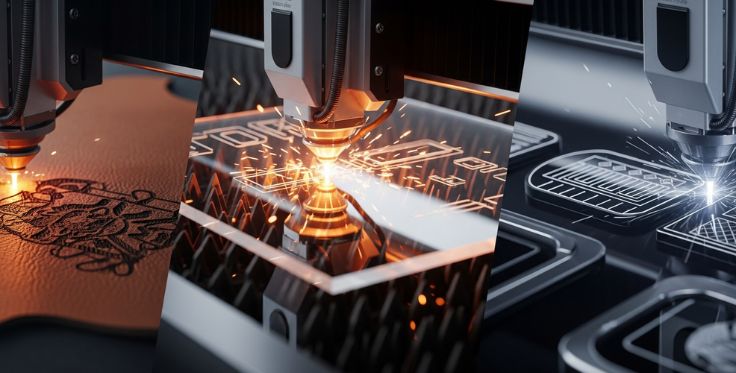
1. Acrylic Cutting
CO₂ laser machines excel in acrylic cutting, delivering:
- Smooth, polished edges
- High precision even in complex shapes
- Consistent quality for mass production
Acrylic is widely used for signage, display stands, lighting fixtures, architectural décor, trophies, and branding materials. With a CO₂ laser, designs that would be difficult with traditional tools become quick and accurate.
2. Leather Engraving and Cutting
Leather responds extremely well to CO₂ laser processing.
Benefits include:
- Highly detailed engravings
- Clean cuts without fraying
- Ideal for logos, patterns, customised accessories and branding
From fashion items and footwear to corporate gifting and craft products, laser-engraved leather has become a preferred choice for designers and manufacturers.
3. Wood, Fabric, Paper, and Other Non-Metals
The CO₂ laser’s wavelength is perfect for organic materials such as:
- Wood
- MDF
- Paper
- Cardboard
- Rubber
- Fabrics and textiles
This makes it suitable for décor items, packaging, promotional products, model making, and design prototyping.
4. Automotive Industry Applications
In automotive manufacturing, CO₂ lasers are widely used for:
- Cutting and trimming plastic components
- Engraving serial numbers and part codes
- Drilling precise holes in dashboards, interior panels, and assemblies
- Trimming excess “flash” from moulded parts
The accuracy and repeatability help maintain strict quality standards required in automobile production. Automation integration also speeds up output and reduces manual handling.
Benefits of Using CO₂ Laser Technology
- High Precision: Ideal for intricate designs and detailed engravings.
- Versatility: Works with acrylic, leather, plastics, wood, textiles, rubber and more.
- Smooth, Clean Cuts: Minimal finishing required.
- Non-Contact Method: No risk of tool marks or material deformation.
- Fast Processing: Suitable for both small customised batches and large-scale manufacturing.
- Supports Both Cutting & Engraving: One machine for multiple operations.
Things to Consider
- Only compatible with materials that absorb infrared wavelength effectively.
- Proper ventilation and safety measures are essential.
- For metal cutting, other laser types (like fiber lasers) may be more suitable.
Conclusion
A CO₂ laser is a powerful, all-in-one solution for industries that require precision, speed, and versatility. Whether it’s acrylic signage, detailed leather engraving, custom décor, or automotive component processing, the CO₂ laser delivers consistent, high-quality results. Its ability to handle both cutting and engraving makes it a valuable asset for modern manufacturing and creative applications alike.